
Insights for Mission-Driven Leaders
Strategic guidance on nonprofit financial leadership, turnaround strategy, and organizational transformation.
The Strategic Nonprofit Finance blog provides actionable insights for nonprofit executives, CFOs, and board members navigating critical financial decisions. Whether you're managing through crisis, planning for growth, or leading organizational change, you'll find practical guidance grounded in real-world experience.

A New Leader’s Tests
A new CEO inherited a large nonprofit where trust with key external stakeholders had collapsed. Her first move looked like a rookie mistake; I assumed she was walking into a lion's den. What she was actually doing was smarter than anything I would have advised, and it holds a lesson for any leader inheriting broken relationships.

The Six Metrics Every Nonprofit Board Should Know
Most board financial reports are long on numbers and short on meaning. Six metrics change that. Together, they give a board a clear read on liquidity, sustainability, and the real availability of an organization's resources. Here are the six, with the formulas and the benchmarks, and the questions every board member can ask.

Basic Needs vs. Quality of Life: How Funders Are Sorting Nonprofits, and How to Stay Funded
Funders are increasingly sorting grantees into two buckets: basic needs and quality of life. Both are charitable. Both strengthen communities. But in a tighter environment, the quality-of-life organizations that keep getting funded are the ones translating their impact into basic-needs outcomes. A New Jersey arts institution figured out how, and it points to a path the rest of the sector can follow.

What Board Trustees Actually Want from Financial Presentations
I have noticed a consistent pattern across client engagements. The first board meeting is the inflection point. Before that meeting, clients are cautiously optimistic. They have hired this fractional CFO and they are hoping he is different from the last finance person. They have been burned before. They are waiting to see. Then the presentation happens, and something shifts in the room.

Net Operating Income vs. Total Net Cash Flow: The Two Questions Every Nonprofit Has to Answer
Jack Stack, author of The Great Game of Business, describes staying in business in two clauses: a business must make money, and it must generate cash. They sound like the same thing. They are not. For nonprofits, understanding the difference is the difference between knowing the model works and knowing you can keep going. Here is the one metric I rely on to hold both questions at once.

Back to Basics: What a Pizzeria Taught Me About Focus
When people talk about strategic planning, they usually talk about growth. New programs, new markets, new revenue streams. But sometimes the smartest move an organization can make is to do fewer things and do them exceptionally well. There is a tiny pizzeria a few blocks from my house that proves it, and its story has almost nothing to do with pizza.

Why Flag Football Is Exploding: What It Means for Every Organization Trying to Build a Future Audience
There is a lesson hiding inside the rise of flag football, and it has almost nothing to do with sports. It is about what happens when a powerful institution stops optimizing for the present and starts genuinely investing in the future. For those of us working in mission-driven organizations, it is a mirror worth looking into honestly.

Before You Spend a Million on Ads, Mail a Bumper Sticker
One of the biggest mistakes organizations make when trying to build brand awareness is assuming the problem is that people dislike them. In many cases, the real issue is much simpler and much more dangerous. People have no opinion at all. No reputation. No emotional connection. No presence in the conversation. The fix is rarely a million-dollar ad campaign. The fix is usually closer at hand and almost free.

Seven Business Books Every Leader Should Revisit
Strong leadership principles are timeless. Here are seven business books I think every leader should revisit regularly, whether you run a for-profit company or a nonprofit, or are thinking about going out or have already started out on your own.

Why Budgets Don't Matter (And What To Do About It)
I often hear a variant of this from finance staff in the nonprofit sector who private message me on LinkedIn. To be clear, this isn't a finance problem. It's a leadership problem. When budgets don't matter, it's because leadership hasn't made them matter.

What Kind of Ancestor Will You Be?
During a week in Utah's national parks, a quote on a sign brought me back to a framing my mentor once shared: think of yourself as an ancestor to the people who will inherit the institution decades from now. It changed how I approach the hardest financial conversations.

The Implementation Gap
Most organizations do not fail because they lack good ideas. They fail because they underestimate how hard it is to implement them. And the system that created the problem is still running when the consultant walks out the door.

When the Board and the ED See Different Numbers
Most nonprofits don't have a finance problem. They have a decision-making problem. The gap between what the board sees and what the executive team knows is where organizations get stuck.

The Bank Account Problem Nobody Designed
Most nonprofits don't have too many bank accounts because someone designed it that way. They have them because nobody designed it at all. Here's what that actually costs — and what to do about it.

The Budget Cut That Backfires Every Time
When budgets get tight, marketing and development are the first to go. That instinct is understandable – and short-sighted. The real structural changes live somewhere else entirely.

Why Most Turnarounds Fail Before They Start
It is rarely a lack of ideas that sinks a turnaround. It is the order in which decisions get made.
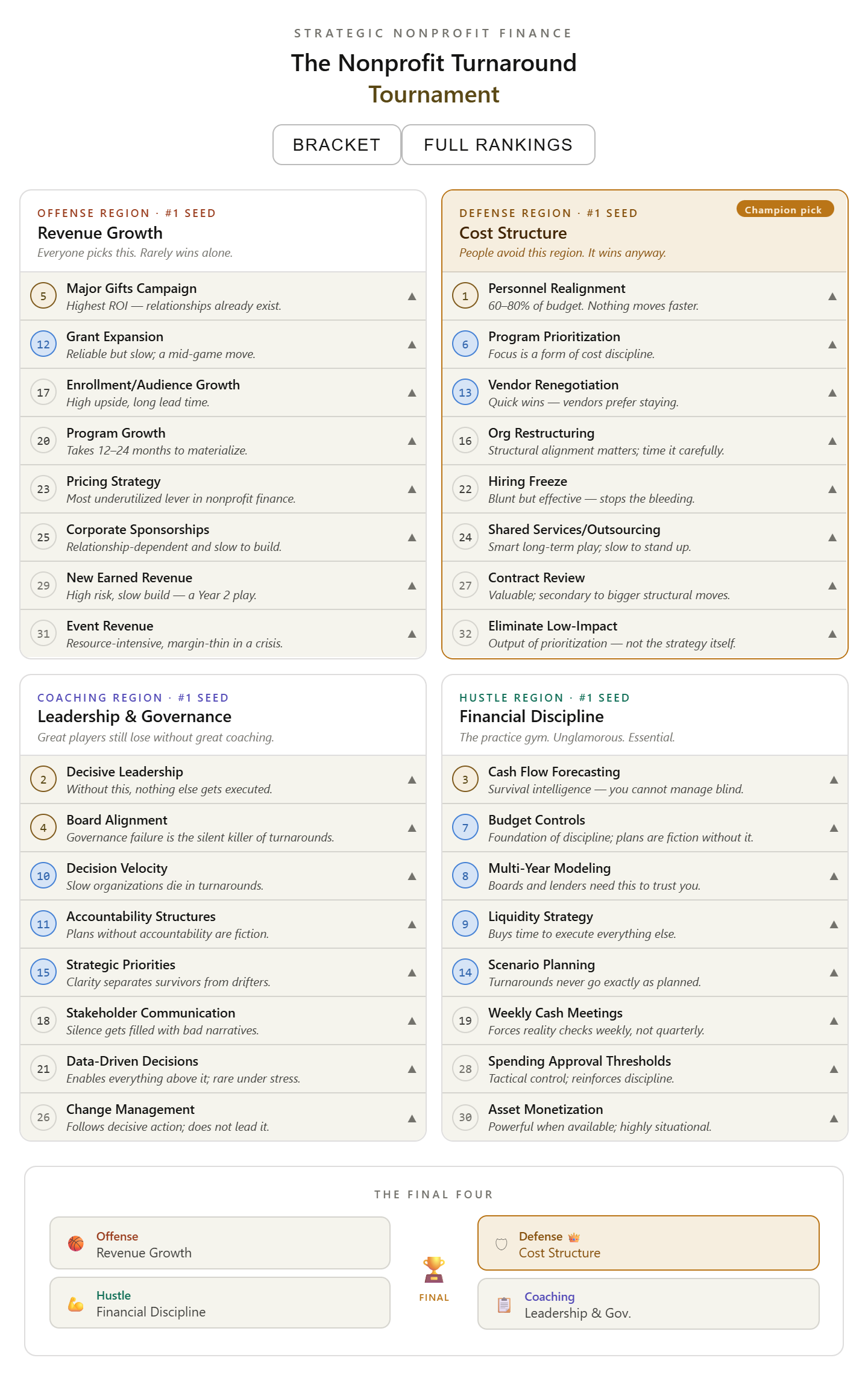
The Turnaround Tournament — A March Madness Bracket for Nonprofit Finance
Everyone wants the big play that saves the day. But four of the top five turnaround moves have nothing to do with revenue.

What Nobody Tells You About the First Year of Going Independent
Two years ago, I left a full-time role and went independent. Here’s what actually happened — the parts people don’t post about.

Timothée Chalamet Opera/Ballet
Chalamet isn't wrong: opera and ballet are losing their grip on culture. The problem isn’t the art - it’s the institutional inertia holding it back. Is it time for a global production consortium to save the performing arts?

Stop Socializing Change. Start Telegraphing It.
"Socializing" sounds like progress. It feels collaborative. It buys time. And it quietly teaches your organization that nothing is real until someone forces it to be.